Why Navesink Twin Lights Has Two Towers
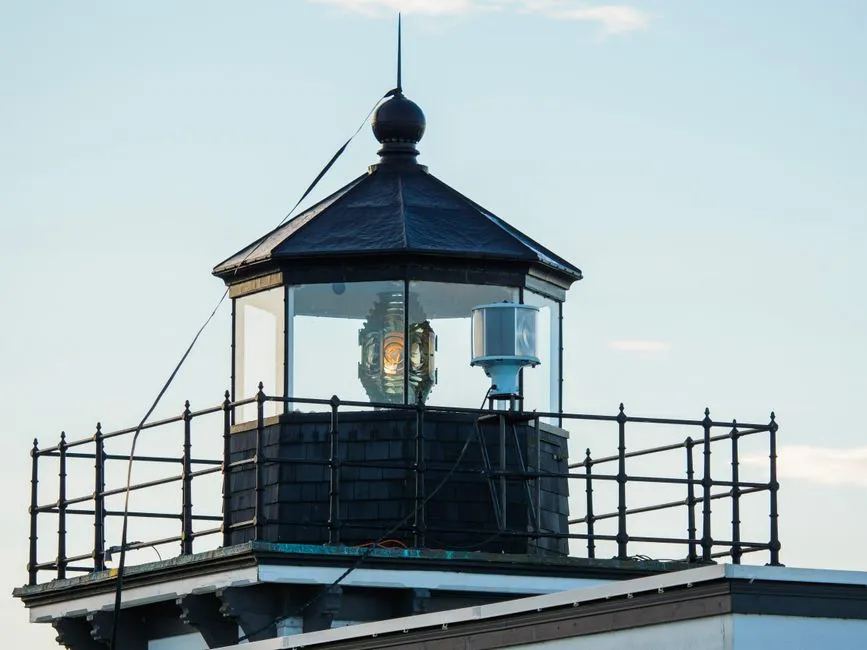
Two towers made one station unmistakable
Navesink Twin Lights has two towers because a paired light station created a distinctive navigational signature. Mariners approaching New York Harbor needed to recognize Navesink and distinguish it from nearby aids such as Sandy Hook Light. During the station's working life, the two towers' lights also used different characteristics—one fixed and one revolving—so the identity worked after dark as well as by day.
The double form was practical communication, not architectural indecision. Long before satellite navigation, a coastline had to introduce itself through position, shape, color, rhythm, and brightness.
The first pair began operating in 1828
The Navesink Highlands rise above the approaches to New York Harbor. The first purpose-built twin lighthouses at the site entered service in 1828. National Park Service documentation explains that their paired appearance prevented confusion with Sandy Hook Light and a nearby lightship.
From offshore, two lights close together could be recognized as Navesink. A fixed light in one tower and a revolving light in the other added another identifying pattern. Mariners did not merely need “a bright thing somewhere ahead.” They needed to know which bright thing, because each signal related to a different location and route.
See beacons and history for more on reading light stations as systems rather than solitary towers.
The current building arrived in 1862
The original structures were replaced by the present linked station in 1862. Its castle-like sandstone form contains two dissimilar towers joined by keeper housing and working spaces. New Jersey's historical account says architect Joseph Lederle designed the unequal towers so mariners could distinguish Twin Lights from other lighthouses during daylight.
The north tower is squared while the south tower is more rounded, giving the skyline an asymmetry that photographs remember. Function shaped the visual identity. The station had to be recognizable when lamps were difficult to see, and the architecture itself became part of the signal.
Keeper families lived inside this working structure. Lighting, maintaining, fueling, cleaning, and monitoring lighthouse equipment demanded labor through the night, while the buildings and grounds required care by day. The heroic beam depended on a great deal of ordinary maintenance and very little dramatic cape-flapping.
Twin Lights became a technology test site
In 1841, before the current building replaced the original towers, Navesink became the first U.S. light station to test Fresnel lenses. These lenses use carefully arranged glass prisms to direct light efficiently over distance. The state records a first-order fixed lens in the north tower and a second-order revolving lens in the south.
Later experiments included mineral-oil lighting and an electric-arc bivalve lens. Navesink's elevation and importance to New York Harbor made it a valuable place to test brighter and more effective systems. The station was not frozen in one era; fuel, optics, power, and signal patterns changed as technology changed.
An exceptionally powerful electric light eventually made the paired working beacons unnecessary, and the north light was taken out of service. That transition answers a useful follow-up: a building can remain Twin Lights even when both towers no longer display official navigational lights. The name describes the historic station and its architecture, not a guarantee that two active beams appear tonight.
The hill carried messages beyond light
Navesink's height also served communication systems unrelated to the lighthouse beam. New Jersey's site history records a semaphore tower in the nineteenth century. In 1899, Guglielmo Marconi used the location in a wireless-telegraph demonstration connected with reporting the America's Cup races off Sandy Hook.
In the twentieth century, electronic and radar-related work associated with nearby Fort Monmouth also used the site. The same geographic advantage kept recurring: a high, exposed point overlooking busy water is useful when signals need room to travel.
These episodes should not be compressed into the claim that the lighthouse single-handedly invented modern communication. It served as a testing and demonstration location within larger technical systems involving many people and institutions.
Why the official lights stopped
Navigation changed through automated lights, offshore structures, radio, radar, and other systems. New Jersey says the Navesink station was decommissioned in 1949 after 121 years of service. A commemorative light may occupy a tower, but the historic station no longer performs its former job guiding ships into New York Harbor.
The distinction matters for both history and safety. Never use a historic or decorative light as navigational information. Mariners must rely on current official charts, notices, aids, equipment, and applicable requirements.
The State of New Jersey acquired the property in 1962 and operates it as Twin Lights State Historic Site. Navesink Light Station later received National Historic Landmark designation, recognizing its national significance in navigation and lighthouse technology.
Read the pair on your visit
When you visit Twin Lights in New Jersey, step back far enough to compare the towers. Notice their different shapes, the central living and working section, the elevated setting, and the water approaches beyond. Then use the museum and official interpretation to connect each visible feature with purpose.
The answer to “Why two?” is therefore layered but simple: recognition. Two towers made Navesink visually distinctive; two differing lights gave it a nighttime signature; later technology changed which lamps were necessary. The architecture survived its original assignment, which is why today's visitors can still read a nineteenth-century message without standing on a ship in the dark.